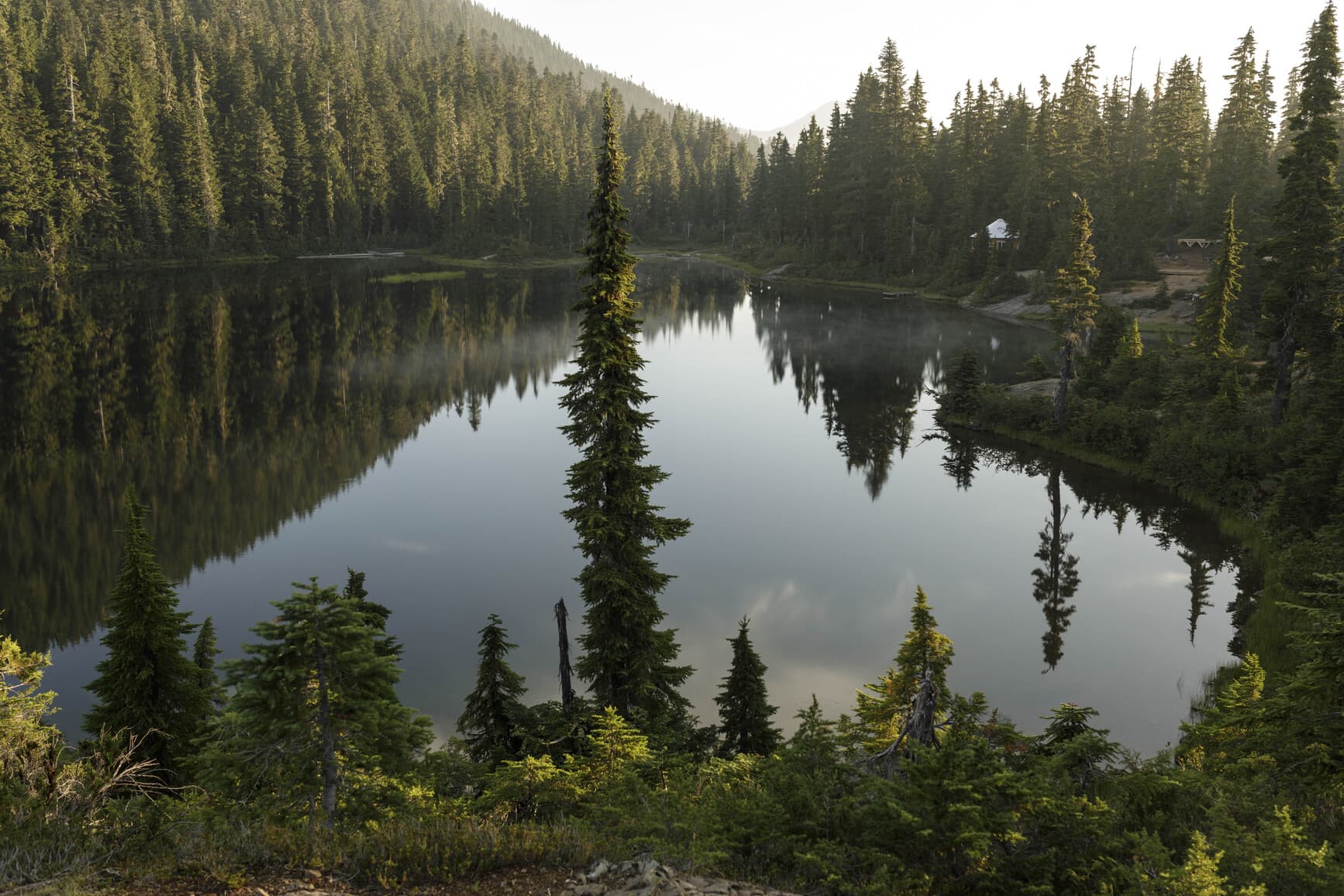
 Croteau Lake from a mountain in Strathcona Park.1 / 7
Strathcona Park
161
Tent Sites
106
Backcountry
Reserve on the official site
Facilities
Activities
About
Strathcona Park, designated in 1911, is the oldest park in British Columbia. Located almost in the centre of Vancouver Island, Strathcona Park is a rugged mountain wilderness comprising of more than 250,000 hectares. Mountain peaks, some perpetually mantled with snow, dominate the park. Lakes and alpine tarns dot a landscape laced with rivers, creeks, and streams.
Summer in Strathcona is usually pleasantly warm, while winters are fairly mild except for the higher levels, where heavy snowfalls are the norm. From November through March, snowfalls can be expected on the mountain slopes and alpine plateaus. Snow remains all year on the mountain peaks and may linger into July even at moderate elevations. Summer evenings can be cool and rain can be expected at any time of the year.
Two areas, Buttle Lake and vicinity and Forbidden Plateau, offer a variety of visitor-oriented developments. The rest of the park is largely undeveloped and appeals primarily to people seeking wilderness surroundings. To see and enjoy much of the scenic splendor requires hiking or backpacking into the alpine regions.
Buttle Lake, named for Commander John Buttle who explored the area in the 1860s, is the major body of water in the park. It and many other lakes and waterways in the park can provide good fishing in season for Cutthroat, Rainbow, and Dolly Varden trout. Della Falls, whose drop of 440 metres over three cascades makes it one of the highest waterfalls in Canada, is located in the southern remote section of the park with the trailhead only accessible by boat at the northwest end of Great Central Lake. And the highest point on Vancouver Island, the Golden Hinde (elevation 2,200 metres), stands almost in the centre of Strathcona to the west of Buttle Lake.
Three roadless tracts within Strathcona Park, Big Den, Central Strathcona, and Comox Glacier, have been designated as nature conservancy areas. Each tract contains outstanding examples of scenery and natural history that remain uninfluenced by human activity. The three areas, totalling 122,500 hectares, are dedicated to the preservation of the undisturbed natural environment.
While the high mountain peaks and deep shaded valleys of Strathcona Park are dramatic, it is easy to forget that beneath your feet lays a history stretching back 380 million years. It is a history of violent volcanic eruptions on ancient seafloors and quiet interludes when gardens of sea lilies waved in gentle ocean currents. It is a history of rocks torn and folded by the extraordinary forces that can move continents, and of mountain ranges sculpted by the immensely thick ice sheets, which only vanished a few thousand years ago. No matter how long your visit, or whatever your interest, a knowledge of the geology of Strathcona Park will enhance your enjoyment of this spectacularly beautiful area.
Strathcona Park benefits from excellent adjoining commercial facilities such as the Strathcona Park lodge and outdoor education centre, which offers outdoor education and wilderness skills training. The nearby communities of Campbell River, the Comox Valley, Gold River, Tofino and Port Alberni offer a full range of visitor services. Mount Washington alpine resort, located adjacent to the park, offers extensive alpine and nordic skiing opportunities, as well as a variety of winter and summer recreation facilities.
The Megin-Talbot addition in Strathcona Park was identified for protection in the Clayoquot Sound land-use decision in 1995.